
All About Glue — Types, Properties and Uses
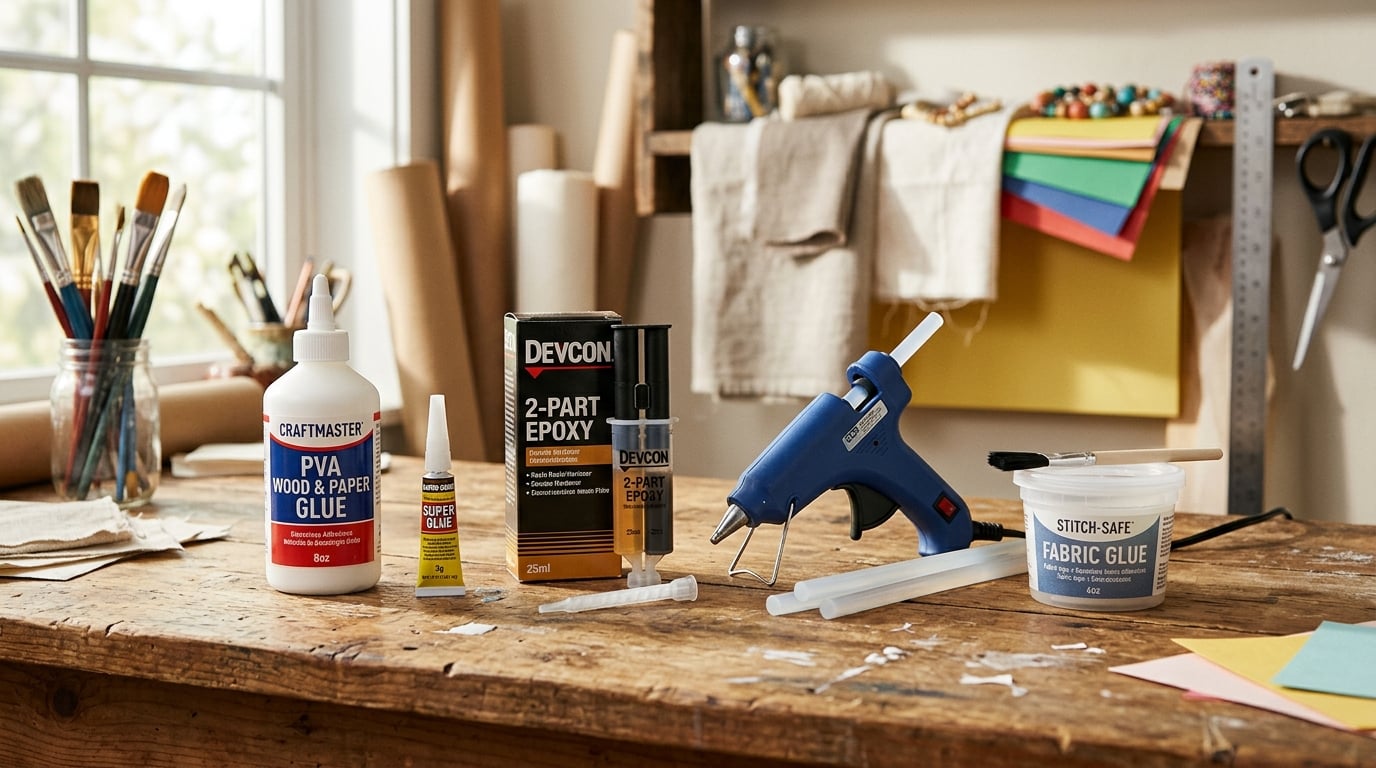
Introduction
From the craft table in primary school to the production lines of heavy industry — glue is an indispensable tool that allows us to bring our ideas to life. In its many forms, this versatile material has the power to bond materials together, providing strength, durability and cohesion. But not all glues are created equal. Depending on the project, one type might be perfect while another simply won't do the job.
In this in-depth article on glue and adhesives, we explore the various types, their properties, uses and more. Whether you're a craft enthusiast, a professional tradesperson, or simply curious, this guide is designed to help you choose the right glue for your projects.
Table of Contents
- PVA Glue
- White Glue
- Wood Glue
- Super Glue (Cyanoacrylate)
- Polyurethane Glue
- Hot Glue
- Epoxy Glue
- Contact Cement
- Fabric Glue
- Animal Glue
- Glue Sticks
- Glue Dots
- Spray Adhesive
- E6000 — Multi-Purpose Industrial Adhesive
- The History of Glue
PVA Glue
PVA glue (polyvinyl acetate) is one of the most common types of adhesive. It is a white, water-based glue that is widely used in woodworking, paper crafts and a variety of other craft projects. PVA glue is known for its strong bond and dries clear, making it popular for projects where the glue will be visible. It is also easy to clean up with water, making it ideal for messy projects.
PVA glue is available in various forms, including liquid, gel and spray. Browse our range of PVA glue products at Föndurlist →
White Glue
White glue, also known as school glue or craft glue, is a subcategory of PVA glue. The name comes from its colour — it is typically white when wet but dries clear, making it ideal for art and craft projects.
White glue is especially popular with children and for school projects because it is non-toxic and easy to use. It can also be used as a sealant and varnish, such as Mod Podge, which is essentially a PVA-based multi-purpose medium that works as a glue, sealant and varnish all in one.
Browse white glue and Mod Podge at Föndurlist →
Wood Glue
Wood glue is a type of PVA glue specifically designed for woodworking. It creates a strong bond between pieces of wood. While all PVA glue can bond porous surfaces and works well on wood, not all PVA glue is suited to every woodworking application.
PVA wood glue is generally stronger and more durable than standard white PVA glue, and often has a longer open time (the time before the glue begins to set), which allows for adjustments after assembly.
Types of PVA Wood Glue
- Yellow PVA wood glue — also known as carpenter's glue. The most common type of wood glue, ideal for indoor woodworking where the joint is clamped. Known for its strong bond but not waterproof.
- White PVA wood glue — similar to yellow PVA wood glue but with lower moisture resistance, less expensive and best used for lighter woodworking projects.
- Water-resistant PVA wood glue — a modified PVA glue that handles moisture better. Suitable for both indoor and outdoor use where the wood will be exposed to moisture but not prolonged contact with water.
- Waterproof PVA wood glue — a modified PVA glue that can withstand exposure to the elements.
While PVA wood glue offers strength and durability, it is not the best choice in every situation. For example, when bonding wood to non-porous surfaces or filling gaps, other adhesive types such as epoxy or polyurethane may be more suitable.
Super Glue (Cyanoacrylate)
Super glue, also known as CA glue, is a fast-acting adhesive known for its strong bond. This glue is typically clear and comes in both liquid and gel form.
The key characteristic of super glue is its ability to cure rapidly at room temperature when it comes into contact with moisture — through a process called anionic polymerisation. The glue reacts to the small amount of moisture present on most surfaces and sets almost instantly.
Super glue is available in different viscosities, from thin and runny (for wicking into tight cracks) to thicker gel (for filling gaps or bonding porous materials).
Things to keep in mind about super glue:
- Becomes brittle once cured
- Sensitive to heat
- Weakens with prolonged exposure to water
- Bonds to skin quickly — handle with care to avoid accidents
- Not suitable for some types of plastic, as it can cause clouding or even cracking
Polyurethane Glue
Polyurethane glue is known for its strong bond and versatility. This adhesive can bond a wide variety of materials, including plastic, metal and wood. Polyurethane glue is resistant to water, heat and cold, making it a popular choice for both indoor and outdoor use.
The key characteristic of polyurethane glue is that it cures by reacting with moisture, either from the air or from the materials being bonded. It typically foams and expands during the curing process, allowing it to fill gaps between surfaces. Once hardened, it can be sanded and painted over.
The best-known brand of polyurethane glue is probably Gorilla Glue. It is important to use it in a well-ventilated area.
Hot Glue
Hot glue (also known as hot melt adhesive) is a thermoplastic adhesive that comes in solid sticks used with a glue gun.
The glue gun has a heating element that melts the glue stick, and the molten adhesive is then pushed out through a nozzle, either with a trigger mechanism or by direct pressure.
Hot glue sets quickly, making it great for projects that require a fast bond. The bond strength is moderate to strong across a wide range of materials, and it is widely used in crafting, home repairs and DIY projects.
Hot glue bonds best to porous materials such as paper, fabric and wood, and is less effective on smooth, non-porous surfaces like metal or plastic. The adhesive is not heat-resistant and can melt if exposed to higher temperatures after curing.
Epoxy Glue
Epoxy is a type of adhesive known for its strong bond, durability and resistance to chemicals and heat. Unlike many other adhesives, epoxy is not a single substance — it is a two-part system consisting of a resin and a hardener. When these two parts are mixed together, a chemical reaction takes place and the epoxy cures into an extremely strong, rigid, plastic-like material.
Due to its strength and durability, epoxy is often used in large-scale applications such as the construction and automotive industries, as well as in various home repairs and craft projects. It is particularly well suited for bonding metal and filling gaps.
Browse 5-minute epoxy at Föndurlist →
Good to know about epoxy:
- Must be mixed in the correct ratio to cure properly
- Short working time once mixed (often 5–30 minutes)
- Can be irritating to skin and eyes — use appropriate safety equipment
Contact Cement
Contact cement is a specialised type of adhesive designed to form a strong bond between two surfaces the moment they touch — hence the name.
What makes contact cement unique is the application method. The adhesive is applied to both surfaces, which are then allowed to dry partially before being pressed together.